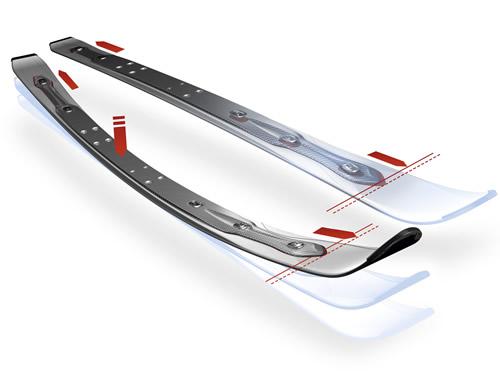
The Flexible, is the ability of a ski to deform under effort. It's often the most misunderstood element: a stiff flex isn't necessarily «better» than a soft flex, it all depends on what you want to do once your boots are on.
1. Flexible (2/10 to 4/10): The playing field
A flexible ski deforms without effort.
- Who is that for? Beginners, featherweights and the kings of Butter.
- The feeling It's fun, it forgives mistakes and it allows you to have fun at low speeds.
- The drawback: At high speed, the ski «vibrates» and loses all grip.
- The SkiPickr example: One Honey Badger or an Elan Playmaker.
2. Flex Médium (5/10 to 7/10): The Swiss Army knife
This is the perfect balance sought by the majority of freestyle-backcountry riders.
- Who is that for? The rider who wants to do it all: park in the morning, powder in the afternoon.
- The feeling Enough responsiveness to hold the curve, enough flexibility not to tire out in three descents.
- The SkiPickr example: L’Armada ARV 100 or the Völkl Revolt 101.
3. Rigid Flex (8/10 to 10/10): The war machine
Here, we're talking about skis reinforced with metal or dense layers of carbon.
- Who is that for? Experts, big guys, and those who love pure speed (Freeride World Tour style).
- The feeling Absolute stability. The ski doesn't move a millimetre, no matter the snow conditions. But beware: if you don't have the leg strength, the ski will dictate your turns.
- The SkiPickr example: The Faction Studio 2 or the Elan Ripstick 102 Black Edition.
4. The «directional» vs «symmetrical» flex»
- Symmetrical The ski has the same stiffness in the tip and tail. Perfect for the park and for switch skiing.
- Directional Often more flexible in the shovel (to facilitate turn initiation) and stiffer in the tail (for better rebound out of turns).
No responses yet